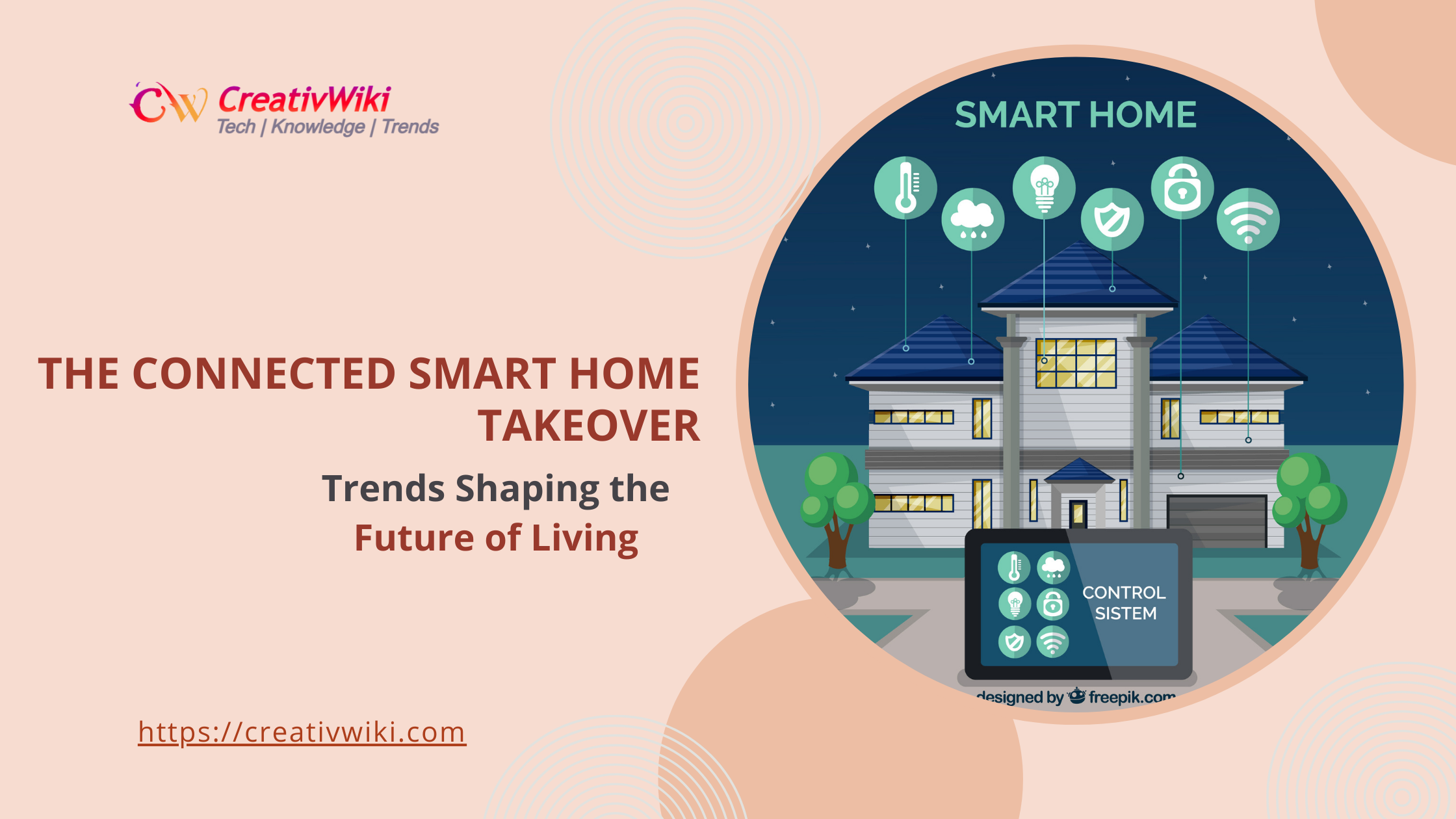
Home is the most personal space for all of us. In this age of convenience living, the concept of Smart Home Revolution represents a transformative shift in residential living, characterized by the integration of interconnected devices and automated systems that enhance convenience, efficiency, and security within the home environment.
The revolution of AI & IOT technologies is also impacting positive results on the smart home projects. Everyone wants an assistant in their home to take care of repetitive tasks and to handle new situations. To fill that, AI is a perfect assistant and is easy to deploy. The current market for smart homes is around 140 US dollars. Experts are anticipating an annual growth of nearly 15%. If the same growth trend sustains till 2030, the market for smart home technologies will touch around 300 billion US dollars. Let’s discuss the basic technicalities of a smart home.
How will the future smart home work?
Before the deep dive, we need to know what makes our home a smart home. The internet-connected appliances, security devices such as video doorbells, pet cameras, and climate control systems like connected thermostats in the home, enable us to control them via a mobile device remotely from anywhere in the world, making our home smart and offering a convenient lifestyle with ease as well as efficiency.
The first step to making your heart is to connect all your appliances, door systems to a centralized network. We can access the network using the internet on our mobile and laptop devices. We can control all the appliances working, control the room temperature, and view security cameras remotely from anywhere in the world. You forgot to switch off the thermostat before leaving for the office? No such worries in case of smart homes. All power is in our hands.
What are the main factors that determine the choice of IoT connectivity?
IoT is a backbone and a transformative technology that made the concept of a connected smart home into reality at a faster rate. The choice of connectivity is typically driven by four main factors: Range (short, medium, or long-range), Bandwidth/Data Rate (small or large amounts of data), Power Consumption (battery-powered or continuously powered), and Cost (hardware and service/subscription).
Protocols of Common IoT Connectivity
IoT utilizes a diverse range of protocols and technologies, broadly categorized by their communication range and power requirements.
Protocol/Technology – Range Key – Characteristics & Use Cases
Wi-Fi Short-Medium – High bandwidth for large data, but high power consumption. Ideal for smart appliances, video cameras, and devices with a constant power source.
Bluetooth Low Energy (BLE) Short – Ultra-low power consumption. Excellent for battery-operated personal devices like wearables (fitness trackers) and proximity sensors.
Zigbee & Z-Wave Short-Medium – Low power, forming mesh networks to extend range. Primarily used in smart home automation (lighting, thermostats) and industrial monitoring.
Lora WAN (Long Range Wide Area Network) Long- Low power, long range (up to 15 km). Suitable for transmitting small packets of data over vast areas, like smart agriculture and smart city environmental monitoring.
How do Automation and Control work?
Automation
- Definition: Automation is the technology concerned with performing a process or a task with minimal to no human intervention, typically by using programmed commands and mechanical, electrical, or computer-based devices.
- Goal: To increase efficiency, productivity, speed, safety, and precision while reducing costs and human error.
Examples:
-
- Industrial: Robotic arms on an assembly line, automated chemical mixing, or fully self-driving manufacturing processes.
- Consumer/IT: A smart thermostat adjusting temperature based on a schedule, or software automatically routing emails to the correct folder.
Control Systems
- Definition: A control system is the core mechanism that manages, commands, directs, or regulates the behaviour of other devices or systems. It is what makes automation possible.
Types:
- Open-Loop: The controller sends a command without checking if the desired result was achieved (e.g., a simple timer).
- Closed-Loop (Feedback Control): The controller uses feedback from sensors to continuously adjust its output, ensuring the target is g., a cruise control system in a car).
Energy Efficiency and Sustainability:
Smart thermostats and energy monitoring systems.
-
What are the main benefits of improving energy efficiency?
Environmental: Reduces the need to burn fossil fuels, leading to lower Greenhouse Gas (GHG) emissions (like $\text{CO}_2$) and improved air quality. Economic: Lowers utility bills for consumers and businesses, frees up capital for investment (cost savings), and creates jobs in manufacturing and installation of efficient technologies. Security: Reduces reliance on imported energy sources, strengthening energy security and stability.
-
What is the difference between Energy Efficiency and Energy Conservation?
Energy Efficiency is using less energy to perform the same task (e.g., using an LED bulb instead of an incandescent bulb). Controlling your smart home from anywhere in the world, you can switch off the lights and electrical appliances that are unused but consuming electricity. Energy Conservation is simply using less energy by reducing the service (e.g., turning a light off when leaving the room).
Convenience and Lifestyle: Voice assistants, smart entertainment, and integrated routines.
- Hands-Free Control allows users to manage devices while cooking, driving, or holding a child. Simply say, “Turn on the kitchen lights” or “Add milk to the shopping list.”
- Information Access provides instant answers to queries (weather, news, traffic, facts) without needing to stop what you’re doing and pick up a phone.
- Accessibility crucially provides an intuitive interface for individuals with mobility, dexterity, or visual impairments, promoting greater independence and control over their environment.
- Communication facilitates quick, hands-free calling, text messaging, and announcements to other devices within the home.
Access Control, Safety & Security: Smart Locks, Security Cameras, Video Doorbells, Smart Alarms, Leak/Moisture Detectors
- The Reader (card reader, PIN pad, biometric scanner) captures the credential data.
- The reader sends this data to the Access Control Panel (the controller or “brain” of the system
- The controller compares the presented data against a stored database of authorized credentials.
- Multi-Factor Authentication (MFA): For enhanced security, the system may require two or more factors (e.g., a card and a PIN) to complete this step.
Authentication Factors Example
- Something you know – Password, PIN
- Something you have – Key Card, Fob, Mobile Phone (as a virtual credential)
- Something you are – Fingerprint, Facial Scan, Iris Recognition (Biometrics)
Conclusion
The smart home revolution culminates in the age of Artificial Intelligence (AI), which fundamentally transforms a “connected” house into an “intelligent” home. AI moves the ecosystem beyond simple, user-programmed automation (like “turn light off at 10 PM”) to proactive, personalized, and predictive decision-making.
Through machine learning, the home autonomously learns user behaviours, optimizing for comfort, energy efficiency, and security—for example, by predicting when to pre-cool a room, identifying a friend versus a stranger at the door, or detecting an abnormal health pattern.
This integration of AI elevates the dwelling from a collection of discrete gadgets to a seamless, adaptive, and intuitive living environment that anticipates and caters to the needs of its occupants.